

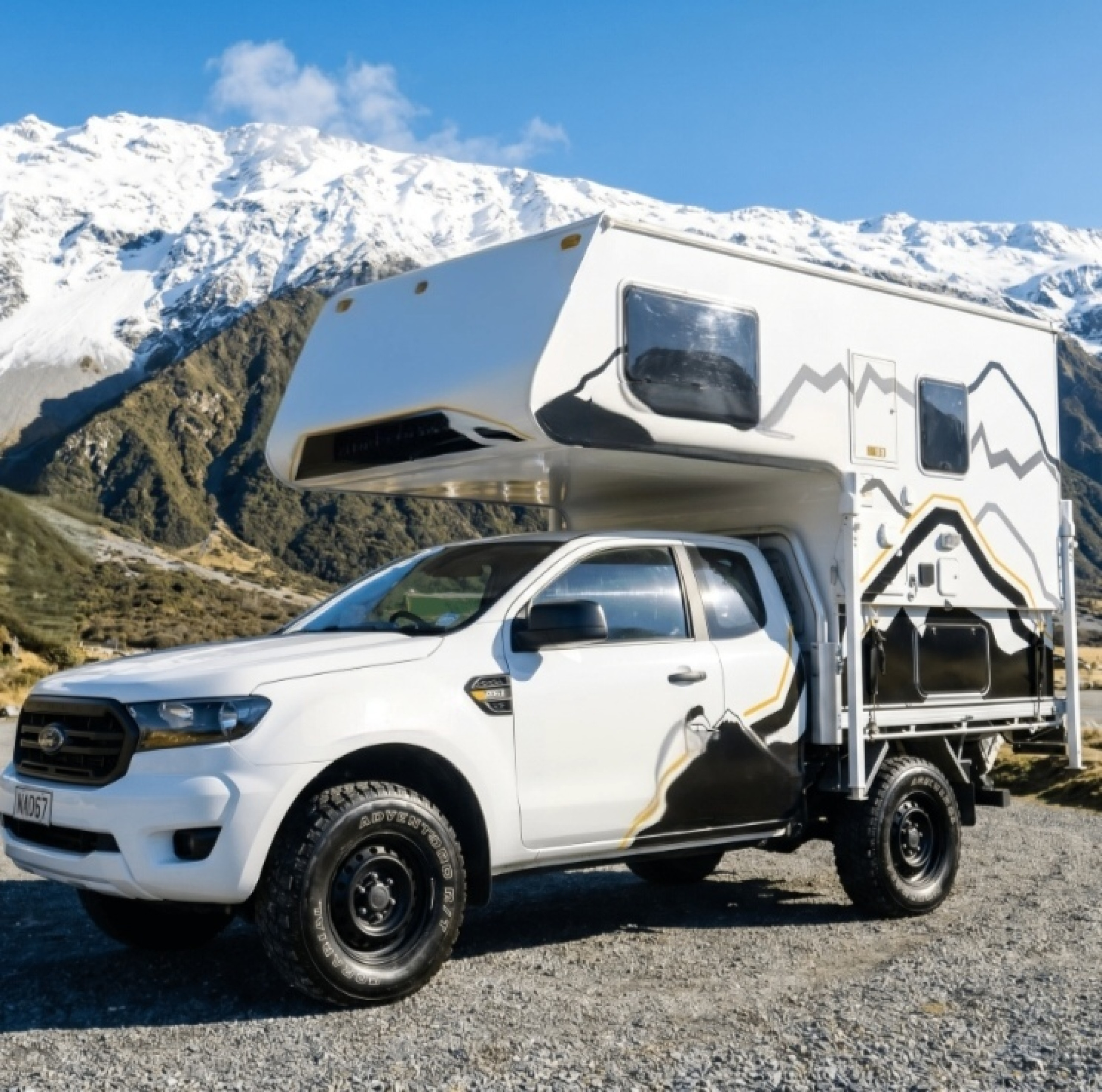
A New Zealand road trip budget starts with an individual vehicle, travel dates and a route. The daily rate may not cover every rental charge, and it says nothing about fuel, overnight stops, activities or crossings. This guide provides a consistent basis for comparing proposals.
References were checked on 12 November 2026. Pampa Cruz starting prices are displayed in euros; local spending and the official fees quoted below are in New Zealand dollars (NZD). Keep currencies separate until you apply a dated exchange rate and the fees your payment provider actually charges.
Free, non-binding reservation request, with no immediate payment.
Starting prices for the two listed configurations
The catalogue lists an Auckland Ford Ranger pickup camper from €250 per day and a Christchurch rooftop-tent Suzuki Jimny from €110 per day. These are displayed starting references, not quotations for your stay.
| 14-day illustration | Displayed-rate calculation | What it represents |
|---|---|---|
| Christchurch Jimny | 14 × €110 = €1,540 | Arithmetic base excluding unconfirmed charges |
| Auckland Ranger | 14 × €250 = €3,500 | Arithmetic base excluding unconfirmed charges |
The actual daily rate, billable duration, minimum hire and included equipment must be confirmed for your dates. The vehicles are on different islands: comparing rates alone may overlook differences in flights, route and comfort.
Ask what the rental total includes
- Billable days, pickup and return times, and possible late-return fees.
- Taxes, preparation, cleaning and required return condition.
- Total included distance and the excess-kilometre rate.
- Bedding, cooking equipment, child restraints and seasonal extras.
- Insurance, assistance, excesses, exclusions and additional drivers.
- Airport transfers, delivery or one-way arrangements only where accepted.
The Jimny listing shows optional bedding and airport transfer services. Confirm whether each charge is per day, per journey or per rental. A listed option does not establish availability at your flight’s arrival time.
New Zealand GST is generally 15%. Ask whether it is already included; do not add it again to a tax-inclusive quotation.
Mileage, fuel and road user charges
Start with the main loop, then add sightseeing, shopping, campsite access and reasonable detours. Confirm the distance allowance in the proposal instead of relying on a generic listing field or a package used in another country.
Excess distance equals the greater of zero and planned distance minus the confirmed allowance. For example, a quotation allowing 1,400 km and a planned total of 1,800 km would leave 400 km to price. This illustrates the calculation and does not establish an allowance for either New Zealand vehicle.
Estimate fuel as distance × confirmed consumption per 100 km ÷ 100 × the local price per litre at travel time. Road user charges apply to diesel vehicles among other categories. Ask whether they are included or charged separately, at what rate and using which mileage record. A statutory rate is not necessarily the contractual rate charged by a rental operator.
Price overnight stays that suit your sleeping setup
List suitable nights by vehicle, sleeping arrangement and season. Separate developed campgrounds, DOC sites and any private land. Do not build the budget around an assumed sequence of free nights: local restrictions and certification requirements may prevent that plan.
The annual DOC Campsite Pass is listed at NZD 295 per adult and NZD 147.50 for ages 5–17, with children under five free. Two adults would pay NZD 590. Compare this with the cost of nights actually covered: site and date exclusions apply, bookable campsites still require reservations, and the pass does not guarantee a space at other sites.
Include paid showers or laundry where relevant, waste disposal and supplies. The camping and self-containment guide explains the checks to make before committing to a night.
Keep insurance and the security deposit separate
A security deposit is money or a card facility that may be held under the agreed terms. It is not automatically a final expense and is not the same as the insurance excess payable following damage. Confirm the amount, payment or pre-authorisation method, cardholder requirements and release conditions.
Compare excesses and exclusions by damage type. Tyres, glass, underbody, roof, camping equipment, unauthorised roads or misfuelling may be treated separately. Ask what an excess-reduction option changes. “Insurance included” does not establish unlimited cover.
Add transport and entry requirements
A two-island itinerary may require ferry fares, vehicle charges, transfers or separate rentals. None of those arrangements is automatically established for the current listings. Confirm the rental agreement first, then use the ferry guide and obtain a dated fare.
Your passport and circumstances determine whether you need a visa or NZeTA and whether the IVL applies. At the time of checking, the NZeTA costs NZD 17 through the official app or NZD 23 online; the IVL is NZD 100 where applicable. Exempt travellers do not necessarily pay these fees. Add flights, meals, activities and a reserve for changes to your plans.
Complete the same comparison table for each quote
| Cost | Calculation basis | Confirmation required |
|---|---|---|
| Rental and extras | Dated total in the quoted currency | Tax, days, equipment, handover |
| Driving | Distance, fuel, applicable RUC | Allowance, consumption, billing |
| Overnight stops | Site × nights × travellers | Compatibility and reservations |
| Protection | Premium/options and deposit separately | Excesses, exclusions, card |
| Other transport | Flights, transfers, accepted ferry plan | Dates and flexibility |
| Daily spending | Meals, activities, formalities, reserve | Personal choices and applicable fees |
Provide your dates, passenger numbers and outline route through the New Zealand catalogue. The reservation request is free and non-binding, with no immediate payment. It lets you obtain availability and specific terms before deciding.