

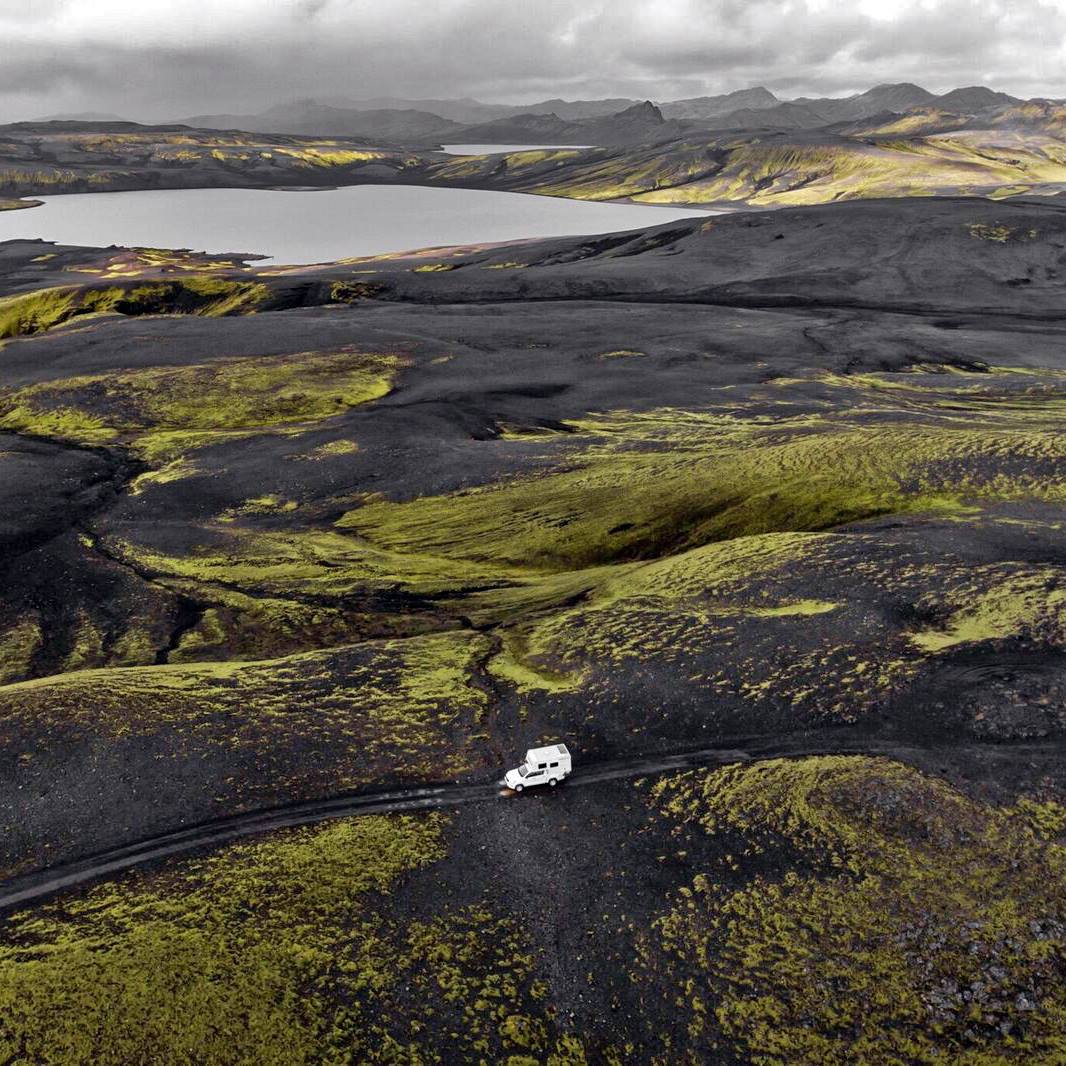
Iceland’s F-roads lead into the remote Highlands, far from the busy Ring Road. These mountain routes take you past lava fields, colourful rhyolite mountains, glacial rivers and extraordinary volcanic landscapes. They also demand considerably more planning than an ordinary Iceland road trip.
The essentials: many F-roads open only in summer, usually from late June or July depending on conditions; a suitable 4×4 is required on routes marked F; and your rental agreement must explicitly allow the roads you intend to use. Never drive on a closed road or attempt an uncertain river crossing.

What are F-roads in Iceland?
The letter F comes from the Icelandic word fjallvegur, meaning mountain road. F-roads are mountain routes that may include rough gravel, steep sections and river fords. They can be closed for much of the year and may be completely impassable after bad weather.
Driving an ordinary two-wheel-drive campervan on an F-road is not permitted. Even if you have a 4×4, do not assume that every F-road is suitable: ground clearance, vehicle size, tyre condition, driver experience and individual rental restrictions all matter. Driving off-road is prohibited in Iceland.
When do Iceland’s F-roads open?
July and August generally offer the best chance of access, but opening dates vary from year to year and between different roads. Some routes open in June; others remain closed until July. Roads may also close again when weather or surface conditions deteriorate.
Before leaving, check the official Icelandic road conditions map, local weather forecasts and guidance from SafeTravel Iceland. Do not rely on yesterday’s information or on a navigation app alone.
For a seasonal breakdown, read our best time to visit Iceland for a road trip guide.
Which Highlands routes are worth exploring?
Landmannalaugar and its colourful mountains
Landmannalaugar is a favourite for its rhyolite mountains, lava landscapes, hot springs and hiking trails. Several mountain-road approaches exist, and they have different driving difficulties. Some routes involve river crossings; the easiest suitable approach depends on the road conditions and your particular vehicle.
Read our dedicated guide to getting to Landmannalaugar before choosing a route.
The Kjölur route through the interior
Route 35 crosses the interior between the Langjökull and Hofsjökull glaciers, passing near the geothermal area of Hveravellir. Its surface is rough in sections and conditions can change quickly. It is not a shortcut to tackle without checking the route and your rental contract; its classification may differ from other marked F-roads.
Askja and the remote central Highlands
The Askja area is particularly remote, with long gravel routes and challenging conditions. Some approaches include substantial river crossings. A casual first-time F-road driver should not assume that a standard rental 4×4 is suitable. Discuss the route with your rental company before travelling and consider a guided alternative.
What type of rental 4×4 do you need?
Compare 4×4 camper rentals for an Iceland Highlands trip, then confirm permission for your exact vehicle and planned roads.
A 4×4 camper or equipped SUV is a starting point, not a blanket permission slip. The most important checks are:
- Allowed routes: confirm which specific roads and river crossings, if any, are permitted by the owner.
- Ground clearance and equipment: check tyres, spare tyre, recovery equipment and the suitability of the vehicle for the route.
- Insurance exclusions: river and water damage is commonly excluded, as are off-road driving and other prohibited uses.
- Weather and road status: even an approved vehicle must not be driven on a closed or unsafe road.
Compare 4×4 campers available to rent in Iceland on Pampa Cruz. A booking request is free and non-binding; the rental partner confirms availability and the rules for the selected vehicle.
River crossings: why you should be extremely cautious
Some Highland routes cross glacial rivers, whose depth and flow can rise quickly, especially after rain or warm weather. A 4×4 does not make a crossing safe, and water damage is often not covered by rental insurance.
If you cannot assess a ford confidently, turn around. Do not follow another vehicle simply because it passed. Never enter deep, fast-moving or uncertain water. For travellers who want to visit challenging places without driving through rivers, a guided tour may be the safer option.
Where can you camp in the Icelandic Highlands?
Campervans and rooftop-tent vehicles must generally use organised campsites or have the landowner’s or rights holder’s permission outside them. Restrictions can be stricter in protected areas. Plan your nights in advance and check when Highland campsites are open. See the official camping rules.
Ring Road or Highlands: which trip is right for you?
If this is your first trip to Iceland and you want a straightforward campervan itinerary, the Ring Road is often the better starting point. If you want remote mountain landscapes and already have a suitable vehicle and driving experience, the Highlands can be a rewarding summer addition. See our Ring Road vs Highlands comparison.
FAQ: driving Iceland’s F-roads
Do I need a 4×4 for F-roads in Iceland?
Yes, an appropriate four-wheel-drive vehicle is required for marked F-roads. Your rental provider must also authorise the specific route.
Can I drive F-roads in June?
Some may open in June, but many do not open until late June or July. Always check the official road status.
Are F-road river crossings covered by insurance?
Do not assume so. Water damage and river crossings are frequently excluded. Read the rental agreement and confirm restrictions directly with the provider.
Is wild camping allowed with a rooftop tent?
Not freely. Overnight stays with campervans and similar vehicle-based camping equipment generally require an organised campsite or permission from the landowner or rights holder.
Ready to plan your Highlands trip? Browse Iceland 4×4 camper rentals and submit a free, non-binding request so the rental partner can confirm the vehicle and its permitted roads.