

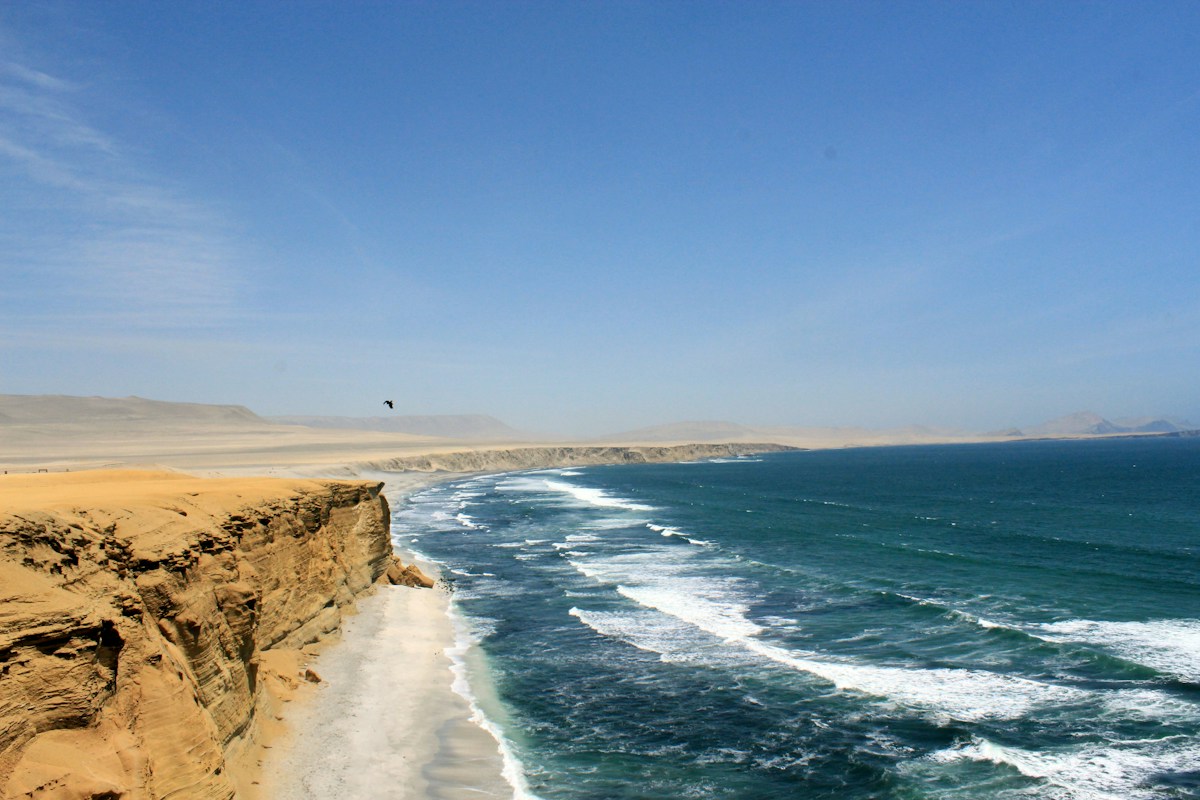
Cover photo: Matthijs Idema / Unsplash.
Updated 19 November 2026. Lire en français
A Peru road trip needs to be planned in days, not just kilometres. Sightseeing, vehicle handover, overnight stops and the drive back all take time. These two suggested return trips from Lima allow 14 days and 13 nights on the southern coast, or 21 days and 20 nights to reach Arequipa, with an optional Colca section.
They are planning examples to adapt to your dates, permitted roads and confirmed vehicle. Both assume collection and return in Lima, which must be agreed in the rental arrangements. Arequipa and Chivay are travel stops here, not promised rental bases. Cusco and Machu Picchu can be planned as a separate part of the holiday, explained below.
Should you allow two weeks or three?
| Length | Route | Indicative distance | Best suited to |
|---|---|---|---|
| 14 days / 13 nights | Lima – Paracas – Ica – Nazca – back to Lima | About 1,000–1,350 km including local driving | An unhurried coastal trip with relatively few long driving days. |
| 21 days / 20 nights | The same coast, then Chala – Camaná – Arequipa – optional Colca – coastal return | About 2,450–2,950 km including Colca and local driving | Travellers comfortable with successive travel days and a plan that allows for altitude. |
The figures below are planning estimates with a modest allowance for access, excluding lengthy visits, closures and major disruption. Local distances are adjustable allowances. Recalculate from the actual handover address, accommodation and chosen stops. Staying within a contractual kilometre allowance does not establish that every road is permitted.
A 2-week Peru road trip: 14 days and 13 nights on the coast
This route focuses on Paracas, the Ica area and Nazca’s archaeology. It returns along the same main road and spends more than one night at several stops. That leaves room to move an outing, do laundry or enjoy a day without packing up. The aim is a relaxed coastal driving holiday, with time for the journey itself.
| Day | Journey and plan | Road type | Estimated km | Estimated driving | Overnight |
|---|---|---|---|---|---|
| 1 | Arrive in Lima; transfer and rest | No rental driving | 0 | — | Lima, booked accommodation |
| 2 | Collect vehicle, check condition and equipment, buy supplies | Urban journeys | 0–40 | Depends on handover location | Lima, confirmed parking |
| 3 | Lima → Paracas; settle in before evening | Pan-American Highway and paved access | 260–280 | 4–5 hr | Paracas |
| 4 | Paracas Reserve; choose visits on permitted routes | Local access to confirm with park and rental provider | 30–80 | 1–2 hr | Paracas |
| 5 | Ballestas boat trip if operating; otherwise contingency or free day | Vehicle remains ashore | 0–20 | 0–30 min | Paracas |
| 6 | Paracas → Ica; settle in, with Huacachina if wanted | Main paved road | 70–90 | 1½–2 hr | Ica or Huacachina |
| 7 | Ica and Huacachina; a walk or booked activity, with no dune driving | Paved local access | 0–30 | 0–1 hr | Ica or Huacachina |
| 8 | Ica → Nazca; an observation stop if time allows | Pan-American Highway | 140–160 | 2½–3½ hr | Nazca |
| 9 | Nazca; chosen visit or separately booked flight | Permitted access roads | 0–60 | 0–1½ hr | Nazca |
| 10 | Nazca → Ica; begin the return north | Pan-American Highway | 140–160 | 2½–3½ hr | Ica |
| 11 | Ica → Paracas; another opportunity for an activity or a rest | Main paved road | 70–90 | 1½–2 hr | Paracas |
| 12 | Paracas → Lima; reach the city in daylight | Pan-American Highway | 260–280 | 4–5 hr | Lima |
| 13 | Contingency day; return vehicle at the agreed time | Urban journeys | 0–40 | Variable | Lima, booked accommodation |
| 14 | Departure; separately arranged airport transfer | No rental driving | 0 | — | No overnight stay in Peru |
Make the most of the time in Paracas and Nazca
Keep the land visit and the boat outing separate in Paracas. The Ballestas Islands are visited by boat, booked independently, with the vehicle left ashore. Day 5 can accommodate a rescheduled outing, subject to conditions and the provider. Returning on day 11 gives another possible opportunity without requiring you to commit to it.
In Nazca, choose between designated observation points and a separately arranged scenic flight. PROMPERÚ’s visitor information explains the ways to see the lines. Keep the vehicle on permitted roads: the archaeological landscape is not an off-road driving area. Day 9 can also become a quiet day if you would rather reduce the amount of sightseeing.
Why return to Lima before the last full day?
Day 12 brings you back to the return area; day 13 remains available before the international departure. It can absorb part of a delay, provide time for the return appointment or leave room to sort out practical details. Avoid committing it to a distant excursion. If everything goes to plan, spend the day exploring on foot and hand back the vehicle at the agreed time.
A 3-week Peru road trip: 21 days and 20 nights
The longer route continues down the coast before turning inland to Arequipa. Chala and Camaná divide the distance into stages and allow for daylight arrivals. Returning along the coastal road keeps the plan independent of an unconfirmed one-way rental. Colca is an optional branch: you must be able to leave it out.
| Day | Journey and plan | Road type | Estimated km | Estimated driving | Overnight |
|---|---|---|---|---|---|
| 1 | Arrive in Lima; transfer and rest | No rental driving | 0 | — | Lima |
| 2 | Vehicle handover, checks and preparation | Urban journeys | 0–40 | Variable | Lima |
| 3 | Lima → Paracas | Pan-American Highway and paved access | 260–280 | 4–5 hr | Paracas |
| 4 | Paracas: reserve or Ballestas, chosen for conditions and interests | Permitted local access or boat | 30–80 | Allow up to 1–2 hr driving | Paracas |
| 5 | Paracas → Ica; Huacachina on foot or as a guided activity | Paved road | 70–90 | 1½–2 hr | Ica or Huacachina |
| 6 | Ica → Nazca; a short visit if time allows | Pan-American Highway | 140–160 | 2½–3½ hr | Nazca |
| 7 | Nazca → Chala; a travel day | Paved Pan-American Highway | 160–180 | 3–4 hr | Chala |
| 8 | Chala → Camaná; breaks at suitable stopping places | Paved Pan-American Highway | 210–240 | 4–5 hr | Camaná |
| 9 | Camaná → Arequipa; settle in and rest | Main paved road, climbing towards Arequipa | 170–190 | 3½–4½ hr | Arequipa |
| 10 | Arequipa; a quiet day with short visits | Walking or local journeys | 0–20 | 0–1 hr | Arequipa |
| 11 | Arequipa; another day without a long drive, then review the Colca plan | Walking or local journeys | 0–20 | 0–1 hr | Arequipa |
| 12 | Arequipa → Chivay only if health and conditions permit | Mountain road with high-altitude sections | 150–170 | 4–5 hr | Chivay; otherwise remain in Arequipa |
| 13 | Colca: Cruz del Cóndor viewpoint and return, without adding a trek | Valley road and access to check | 80–100 | 3–4 hr return | Chivay; otherwise Arequipa |
| 14 | Chivay → Arequipa; no major extra visit on the travel day | Mountain road | 150–170 | 4–5 hr | Arequipa |
| 15 | Arequipa → Camaná | Main paved road | 170–190 | 3½–4½ hr | Camaná |
| 16 | Camaná → Chala | Pan-American Highway | 210–240 | 4–5 hr | Chala |
| 17 | Chala → Nazca | Pan-American Highway | 160–180 | 3–4 hr | Nazca |
| 18 | Nazca → Paracas via Ica | Pan-American Highway and Paracas access | 210–250 | 4–5½ hr | Paracas |
| 19 | Paracas → Lima; arrive in daylight | Pan-American Highway | 260–280 | 4–5 hr | Lima |
| 20 | Contingency and vehicle return at the agreed appointment | Urban journeys | 0–40 | Variable | Lima |
| 21 | Departure; keep time available until the airport transfer | No rental driving | 0 | — | No overnight stay in Peru |
Three nights in Arequipa do not guarantee acclimatisation
Days 9–11 provide three nights in Arequipa before a possible ascent. This creates time, without proving that everyone is ready to go higher. The CDC’s guidance emphasises gradual ascent and responding to symptoms. Seek medical advice before travelling where appropriate, and do not continue upward if symptoms develop.
If Colca is unsuitable, remain in Arequipa for days 12–14 and then follow the planned return. The driving distance will be lower. Alternatively, begin the coastal return earlier and keep the extra days available. There is no need to replace a cancelled mountain section with another demanding route just to use the time.
Colca viewpoints and canyon trekking require different schedules
The MINCETUR inventory places Cruz del Cóndor around 42 km from Chivay. Day 13 allows for the return drive and a limited number of stops. Condor sightings depend on wildlife and conditions. Hiking into the canyon needs a separate plan, with its own days, preparation and appropriate support.
The return stages have similar driving allowances to the outbound journey. Time in a city does not make up for a tiring night drive. If you fall behind, remove a visit and shorten that day’s journey. Arrange the Chala and Camaná overnight stops before leaving Arequipa, rather than relying on finding a place after a delayed arrival.
How the distances and driving times were estimated
The starting points are the SERNANP access information for Paracas, the official Ica and Arequipa visitor guides, and MINCETUR route inventories. Figures are rounded into ranges to avoid suggesting door-to-door accuracy.
The Ministry of Culture’s Rutas Ancestrales gives approximately 170 km between Nazca and Chala. The roughly 220 km allowance for Chala–Camaná is an estimate derived by comparing the official Chala–Arequipa and Camaná–Arequipa journeys. The exact overnight address changes the result. None of these figures confirms that a road will be open on your travel day.
Overnight stops and daily camper routines
The overnight column names an area, not a booked campsite. At every stop, confirm that the place accepts your vehicle, permits an overnight stay and can accommodate your arrival time. Ask which facilities are actually available. Accommodation with suitable parking can be useful in towns; include hotel nights in the budget even if the vehicle has its own bed.
In Lima, arrange accommodation and parking rather than an improvised beach overnight. French government travel advice warns against Lima’s beaches at night. In Paracas, ask the reserve manager about current sectors and permissions before planning to camp inside the protected area. Our camping in Peru guide covers drinking water, power, waste and supplies. Check the vehicle’s exact fuel requirement and use Osinergmin’s Facilito to help identify fuel stops.
Keep a simple daily routine: confirm the next night’s stop, check water and food, review fuel options and leave time to arrive before dark. A rooftop tent or camper body changes how you sleep; the usable facilities still depend on the specific vehicle. Avoid building the route around an assumed shower, heater or large water tank.
Seasons, road conditions and changing the plan
The coast and Andes need different seasonal decisions. Read our guide to the best time for a Peru road trip before choosing the longer route. Check SUTRAN road alerts before each stage and obtain local advice if an access road is uncertain. A diversion suggested by a navigation app may be unsuitable or outside the rental agreement.
Check again for late 2026 and early 2027: the FCDO warns of heavy rain and disruption associated with El Niño through April 2027, particularly on the northern and central coast. Current advice and local conditions take priority over the usual seasonal pattern. Schedule driving in daylight and do not attempt to cross a roadblock.
Add Cusco and Machu Picchu as a separate stay
If Machu Picchu is central to your holiday, allow several additional days after returning the vehicle in Lima and arrange onward travel to Cusco separately. Alternatively, shorten the road trip and allocate part of your two or three weeks to that region. In either case, rebuild the whole calendar: travel and acclimatisation days still need to be included.
The usual approach continues from Ollantaytambo by train, followed by an authorised transfer or a walk. Check named admission, date, time and route against the official visitor rules before choosing the train. For a different overland journey towards Cusco, check the regional advisories first. The route through Abancay should not be an automatic choice: it is subject to a French travel warning in the advice checked on 19 November 2026. Also consult the guidance applicable to your nationality and insurer.
Use the route to make a clear rental request
Provide your dates, passenger numbers, preferred collection and return locations, and main overnight areas. Ask for confirmation of permitted roads, kilometre allowance, equipment, insurance terms and handover times. A 14-day holiday does not necessarily mean 14 billed rental days: the contract’s collection and return times determine the chargeable period.
Our driving in Peru guide helps with those checks. Use the road trip budget guide to add fuel, overnight stays, tickets and separately booked activities. If you are still choosing a region, start with our Peru highlights for an adventure trip.
Send a free, no-obligation request with no immediate payment. Vehicle availability and terms must be confirmed. These route examples are not an inclusive tour package with accommodation, activities or support supplied.
Questions about these Peru itineraries
Is a 4×4 essential?
The main intercity journeys use paved roads. Vehicle choice also depends on the living arrangement you want, the condition of permitted access roads and the rental agreement. Four-wheel drive does not make a track open or insured.
Can I return the vehicle in Arequipa or Cusco?
These examples assume return to Lima. Any different handover requires confirmation for the specific vehicle, dates and fees before the route is changed.
Can I use the buffer days for more sightseeing?
Keep the plan flexible before vehicle return and the international flight. A buffer protects the schedule but cannot guarantee that a prolonged closure will be absorbed. Choose nearby, changeable visits once you know the journey is on track.
Sources checked on 19 November 2026. Distances, overnight stops and timings are planning assumptions to recheck against your travel arrangements and current conditions.