

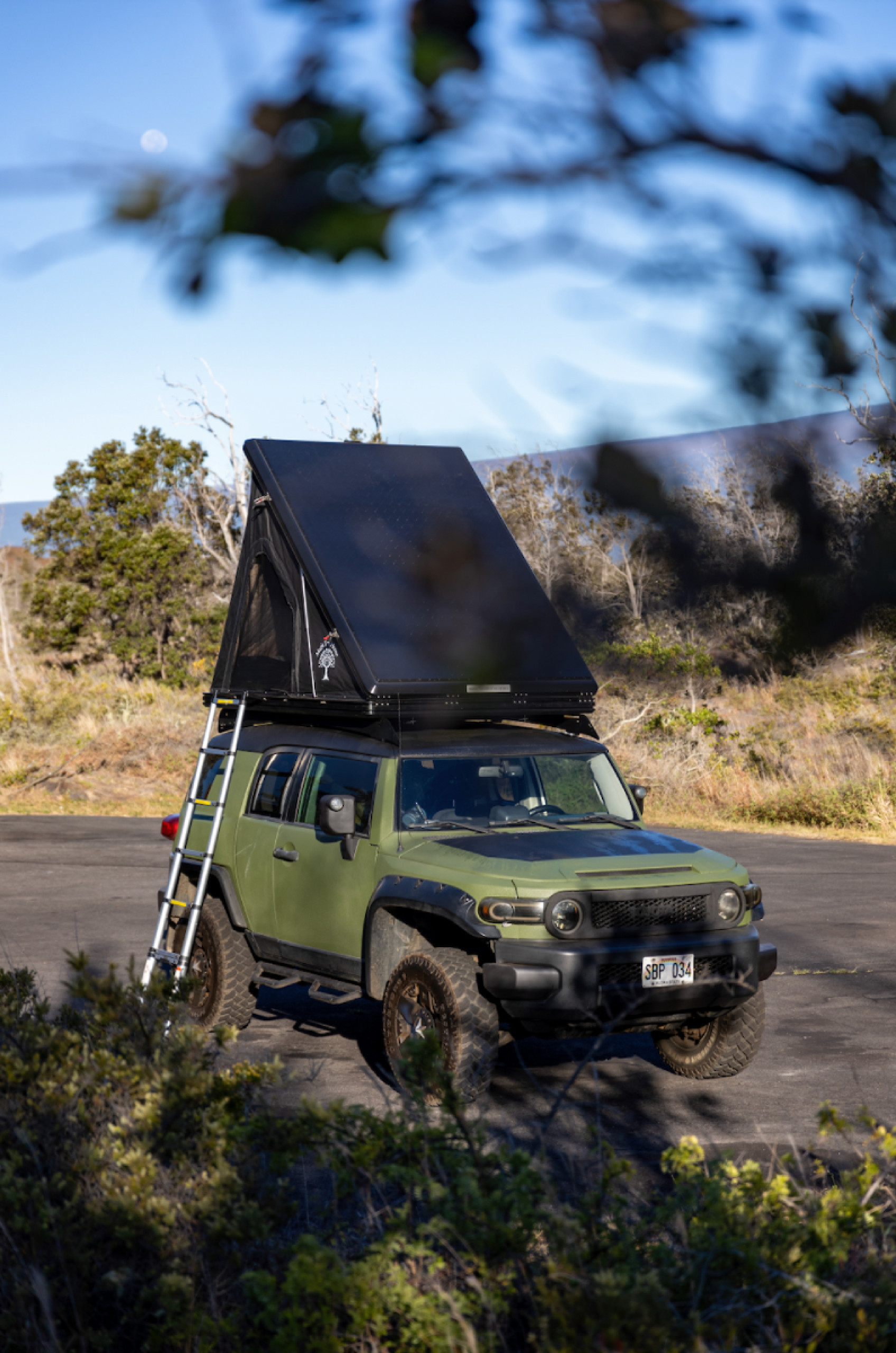
Big Island is the island of Hawaii, one island within the Hawaiian archipelago. When travelling with a rooftop tent, vehicle choice and overnight planning belong together. A campground shown on a map may accept ground tents without allowing you to sleep on top of a 4×4, while a sightseeing parking area may close before you arrive.
The Big Island rooftop-tent rentals offered from Kona are the commercial starting point for this guide. Places to visit do not become additional collection bases. Rules and displayed fees were checked on 12 November 2026 and should be checked again for your travel dates.
Identify the overnight arrangement before selecting a campsite
Ask three separate questions: is the site open, can your vehicle reach the space, and is sleeping on the vehicle permitted? A positive answer to only one is insufficient. A ground-tent site may require leaving the 4×4 in a separate parking area.
| Arrangement | Confirm | Useful evidence |
|---|---|---|
| Ground tent | Equipment and authorized camping area | The appropriate camping permit |
| Rooftop tent | Explicit acceptance of the installation | Confirmation for the space and dates |
| Private land | Permission to park and sleep overnight | Operator agreement and booking |
Hawaii’s rules on using vehicles as sleeping places do not permit an improvised roadside or private-property stay without the appropriate authorization. Build the itinerary with an identified option for each night, rather than hoping a suitable parking space will appear.
County parks: a permit is not proof of vehicle-camping access
The County of Hawaii camping rules provide for designated camping areas and freestanding tents. A permit should not be interpreted as general permission to open a rooftop tent in campground parking areas.
Chapter 15 of the county code names designated spaces for recreational vehicles or other camping units at Whittington and Spencer. That provision does not establish current availability or acceptance of your particular setup. Ask the parks department which exact space may be used and what permit applies before building a night around it.
The official booking portal requires permits to be purchased in advance, not at the parks. On 12 November 2026, it lists nonresident fees of US$21 per person per night from age 13, and US$20 for children aged 12 or younger. Those prices do not confirm vehicle compatibility.
Kalōpā and Kīholo have specific camping arrangements
The Hawaii Island State Parks camping page prohibits sleeping in vehicles in campground parking lots. Do not apply the campervan exception sometimes mentioned for Maui to Big Island. Different islands and land managers have different rules.
Kalōpā offers forest ground-tent camping. Check reservations and current facilities; cabins were listed as closed through the end of 2026 when this guide was checked. They should not be treated as an automatic replacement for a camping night.
At Kīholo, camping nights are limited to Friday through Sunday, with reservations up to 30 days ahead. The park lists no water, portable toilets and gates locked overnight. Its gravel access road must also be acceptable under your rental contract. A reservation does not override restrictions on sleeping arrangements, so confirm the complete plan before travelling there.
Camping near the volcanoes: road access does not settle sleeping rules
Hawaiʻi Volcanoes National Park describes two road-accessible campgrounds: Nāmakanipaio and Kulanaokuaiki. Their NPS listings classify the pitches as tent-only and state that RVs are not allowed. At Kulanaokuaiki, the pitches are walk-in. These descriptions do not establish suitable rooftop-tent overnight stops.
For the tent pitches described on those pages, the NPS lists first-come, first-served operation without reservations. A ground-tent plan therefore also needs an alternative if the campground is full. Check current arrangements with the operator, distinguishing tent pitches from any other accommodation offered.
Nāmakanipaio has water and restrooms; Kulanaokuaiki has no water and uses vault toilets. Daily needs therefore differ between the two. Park entry is separate from campground charges: consult the official fees page for your visit rather than assuming one payment covers everything.
Keep the overnight location separate from the volcanic sightseeing objective. The park’s safety guidance emphasizes closures, designated areas and air quality. Lava viewing cannot be guaranteed even when visitors can enter the park. Allow time to reach your actual overnight stop after the day’s activities.
Maunakea and unpaved roads are not overnight alternatives
The Maunakea land manager’s rules prohibit camping and overnight sleeping on the managed lands. An evening of stargazing must end at your accommodation or authorized overnight location, with its latest arrival time taken into account.
Above the Visitor Information Station, vehicle, altitude and road-access requirements sit alongside the rental contract. Do not turn four-wheel-drive capability into a promise that summit driving is included. Saddle Road and the summit road are different routes, and each part of the proposed journey must be considered separately.
In State Parks, driving and parking are restricted to designated areas. Ask for the rental company’s exact exclusions for dirt roads, beaches, private access roads and roadside assistance. If an access is closed or prohibited by the agreement, choose another visit; camping equipment creates no special access rights.
Build your Kona loop around confirmed nights
Start with vehicle handover and return times. A late flight may justify a first accommodation night, followed by collection the next morning, so you can learn the setup without rushing. Arrange this explicitly rather than assuming an overnight handover or accommodation is included.
For each evening on the proposed loop, record the location, accepted sleeping arrangement, reservation, available water and arrival deadline. Add sightseeing afterward. If the only compatible campsite requires backtracking, it is better to see that before every day has been fixed around distant attractions.
Our seven-to-ten-day Big Island itinerary is a flexible framework. Hilo, the volcanoes and coastal areas are places to visit, not automatically delivery locations or certified rooftop-tent campsites. Do not plan to take the rental to another island without explicit agreement. For a multi-island holiday, first establish a separate transport and sleeping plan for each island.
Water, toilets, cooking and the complete trip budget
Request an equipment list for your chosen vehicle, including water capacity, sleeping places, bedding, food storage and cooking equipment. Check how any fridge is powered and where luggage fits. “Equipped for camping” is a starting description, not a substitute for these details.
At each overnight location, establish drinking-water access, toilets available at night, showers, waste disposal and cooking rules. A portable shower or stove does not authorize every use on the site. Keep the operator’s contact details and a booking copy available offline. Allow time to replenish water and food before reaching a place with limited facilities.
Then calculate the complete stay: rental quote, compatible overnight spaces, taxes, extras, fuel, food and activities. Keep some flexibility to replace a camping night. The Hawaii budget guide organizes these costs, while the season guide helps with clothing and itinerary flexibility.
Common questions for rooftop-tent travel
Does a camping permit allow me to sleep on the 4×4?
Not automatically. Check that the specific site category and rules accept your installation. A ground-tent permit can be incompatible with rooftop camping.
Can a ground tent supplement the vehicle?
Yes, provided you have suitable equipment and book an authorized space. Confirm whether a separate tent is included or offered as an extra; never assume it is supplied.
Do I need a different campsite every night?
Not necessarily. Staying two nights in one place can simplify the trip when sightseeing and stay limits allow it. The right pace depends on confirmed overnight options and how much driving you want.
Compare the rooftop-tent 4×4 listings from Kona and read the individual details. Your booking request is free and non-binding, with no immediate payment. The Hawaii rental page distinguishes this offer from vehicles on Kauai.
Information and catalogue checked on 12 November 2026. Recheck opening status and terms for your dates.