

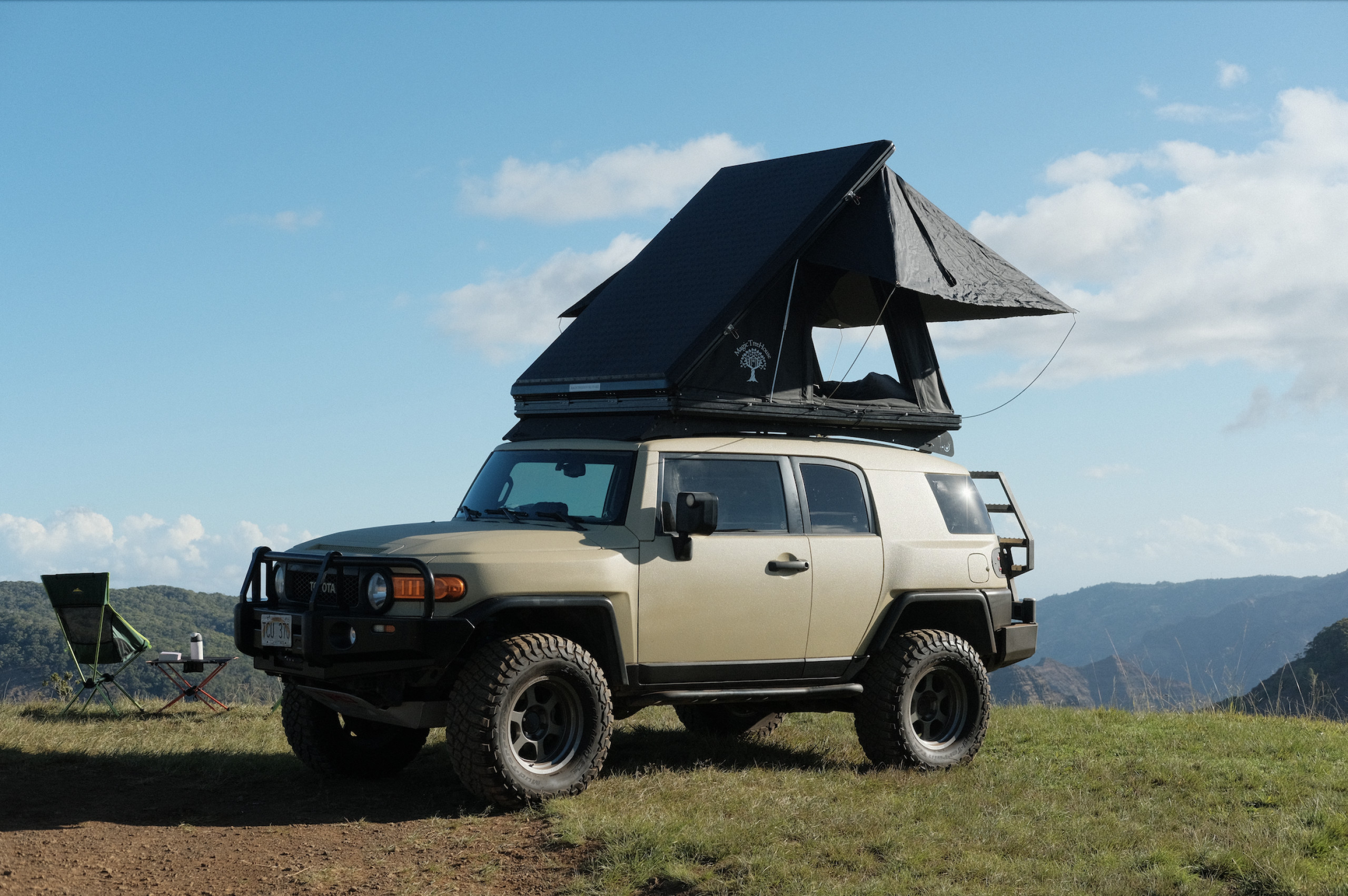
Planning a Kauai road trip with a rooftop tent starts with the overnight stops. Your vehicle provides a bed and carries your equipment, but it does not grant permission to camp beside any beach or in any available parking space. Rules depend on the land manager and the exact sleeping setup.
This guide explains the differences, the questions to ask and a practical booking sequence. Rules and notices were checked on 12 November 2026. Start with the rooftop-tent 4×4 rentals offered on Kauai, while checking campsite availability separately. A published vehicle listing does not confirm either the vehicle or an overnight pitch for your dates.
Parking permission and camping permission are different
Before paying for a campsite, establish exactly what the booking covers. A parking permit may simply allow ground-tent campers to leave their car while carrying equipment to a separate camping area. A rooftop tent needs a vehicle-accessible space and permission to use that sleeping arrangement.
| Booking or location | Check | Does not automatically include |
|---|---|---|
| Day-use parking | Opening hours and signs | An overnight stay |
| Ground-tent pitch | Permit, camping area and dimensions | A rooftop tent |
| Vehicle camping space | Acceptance of your exact setup | Permission elsewhere |
Hawaii’s vehicle-habitation law restricts overnight use on public property and requires permission covering both parking and habitation on private land. Confirm an authorized place to sleep before setting off; a quiet roadside location is not a booking alternative.
Kauai county campgrounds are for ground tents
The County of Kauai campground rules require campers to sleep in tents and prohibit mobile or vehicle camping. Vehicles stay in designated parking areas. Do not buy a county camping permit assuming that you can open your rooftop tent beside your car.
The county lists ‘Anini, Anahola, Salt Pond and Lydgate among its campgrounds. Its camping information page also gives weekly maintenance closures. These affect a sequence of nights, even when two sightseeing stops look close together on a map.
At the 12 November 2026 check, the parks department’s current notice included a Salt Pond closure and closure of Morgans Pond at Lydgate Beach Park. The latter concerns the swimming area; the campground’s status requires a separate check. Temporary conditions can change. A campground appearing in a travel guide establishes neither its current opening nor its suitability for your sleeping setup.
State Parks: separate sightseeing from overnight plans
Kauai’s State Parks do not allow sleeping in vehicles in their campground parking lots. A ground-tent permit does not remove that restriction. Backcountry camping along the Nāpali Coast involves a different type of trip and should never be presented as a stop reached with your rental 4×4.
The DLNR announcement dated 8 November 2026 reports daytime reopening of Kōkeʻe and Waimea Canyon from 7 November, with reduced services, but states that Kōkeʻe campground remains closed. Some general notices still contain conflicting information. At the 12 November check, an overnight stay at Kōkeʻe should therefore not be assumed possible; check the campground status again for your dates.
For Polihale, the manager warns that rain can make the access road impassable and rental companies may prohibit it. The general camping page listed camping as suspended. A 4×4 should therefore not make Polihale your improvised fallback for an unbooked night.
How to confirm a rooftop-tent-compatible overnight stop
For private land or any other place advertised as suitable, request confirmation for your exact installation. A van photograph, an old review or the word “camping” does not resolve all the details. Send your vehicle model, relevant dimensions, party size and dates, explaining that the tent opens on top of the vehicle.
- Does the operator accept this setup on the particular space you are booking?
- Does permission cover sleeping overnight as well as parking?
- Are toilets accessible throughout the night?
- Do the entrance, surface and space around the vehicle suit the ladder and open tent?
- What happens if access closes or conditions prevent the tent from being used?
Keep the written answer with your booking confirmation. This guide does not certify an individual private campground. Its authorization, current operation and acceptance of your setup need to be established for that location. An advertisement alone is not confirmation.
A practical order for booking the trip
Begin with dates, party size and the areas you would like to explore. Ask about the vehicle you are considering, separating seats with seat belts from sleeping capacity. Families should also check child-seat arrangements and whether climbing into the tent is appropriate for everyone travelling.
Work on nights at the same time. For every date, record the campsite or accommodation, written acceptance, arrival window, facilities and a replacement option. An empty night in the plan should not be filled with an assumption that you will find a parking lot when you arrive.
Once those arrangements fit together, place the sightseeing days around them. Our seven-day Kauai itinerary provides a framework to adapt. It does not replace campsite bookings or promise that rooftop camping is available in every area visited. Fewer changes of camp can also leave more time for activities and reduce repeated packing.
Facilities and daily routines matter
Ask what the vehicle actually includes: bedding, lights, cooler or fridge, water storage, cooking equipment, table and chairs. Confirm quantities and operation. A portable shower, if offered, does not automatically replace campsite facilities, and a listing that mentions water does not necessarily specify the capacity available.
For each night, check drinking water, toilets, showers, cooking rules and waste disposal. Aim to arrive with time to find the correct space and set up without rushing. Ask for a tent-opening and packing demonstration at handover, then check luggage space with the bedding stowed. Decide where wet items will go so they do not soak the sleeping area.
Keep a light, shoes, rain layer and booking details easy to reach. With children, consider the night-time walk to the toilets and how adults will manage the ladder. These ordinary details often determine whether camping feels comfortable.
Budget for the complete stay and recheck before departure
Compare the total trip cost: a quote for your dates, confirmed taxes and extras, overnight stays, fuel, food, visits and any accommodation night. A ground-tent campsite tariff is not a quotation for rooftop-tent camping. Read cancellation and amendment conditions so you know which nights can be moved if plans change.
Add “confirmed on” and “recheck before travel” columns to your itinerary. Permission obtained months earlier should be followed by an opening and access check close to departure. Use the official State Park notices and county updates for closures rather than relying on old visitor comments.
Our Hawaii rooftop-tent budget guide helps organize the expense categories. The season and preparation guide supports decisions about dates, weather and equipment. Keep some flexibility for an accommodation alternative if a camping night becomes impossible.
Common questions before choosing a vehicle
Can I sleep anywhere with a rooftop tent?
No. You need a place that permits that particular overnight use and any required permit or permission. An accessible road or an empty parking space is not authorization.
Could I use a ground tent instead?
Only if you actually have the equipment and a campsite that allows it. Do not assume a separate tent comes with every rental: confirm capacity, equipment and any additional charge.
Should every night be planned?
Having an authorized option for each night is the clearest way to establish that the trip works. Keep an alternative you can check if a closure occurs.
Browse Kauai’s listed rooftop-tent vehicles and open the individual listing suited to your party. A Pampa Cruz booking request is free and non-binding, with no immediate payment. Return to the Hawaii rental page to compare the documented island options.
Information and catalogue checked on 12 November 2026. Recheck opening status and terms for your dates.